
The Urban Intelligence Impact Award Honors Leadership Shaping a Regenerative Future
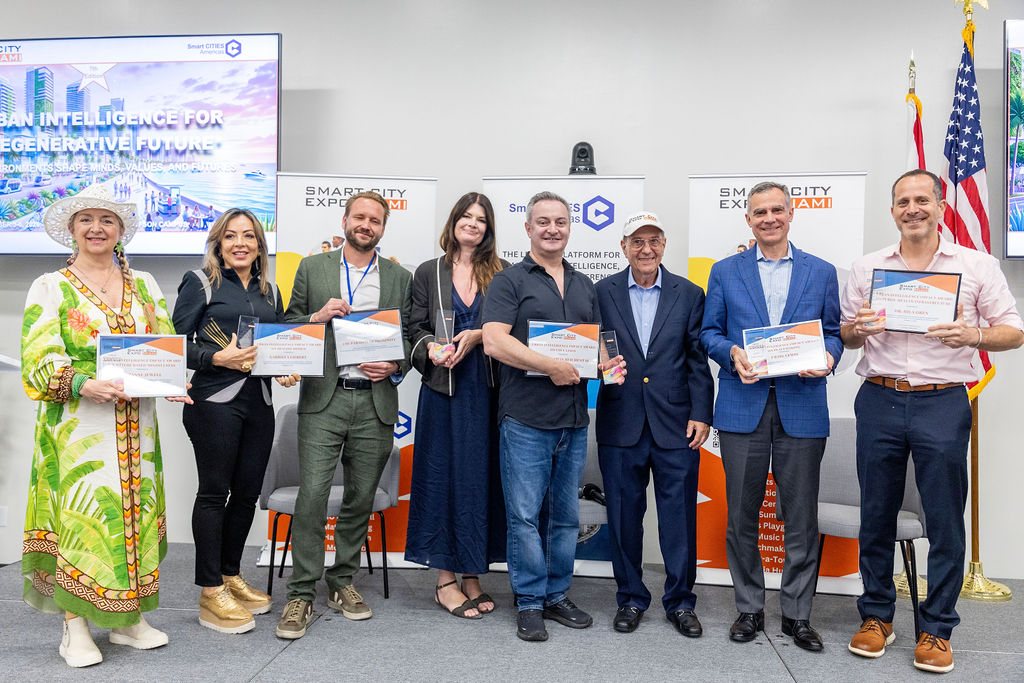
SCEM26 - Urban Intelligence Impact Award
Ceremony recognizes contributions to education, placemaking, public health infrastructure, healing design, nature-based mindfulness, and the book of the year.
MIAMI, FL, UNITED STATES, October 14, 2026 /EINPresswire.com/ -- Smart Cities Americas, producer of Smart City Expo Miami, honored six award recipients across disciplines shaping the future of urban life at the Urban Intelligence Impact Award Ceremony on October 5th, 2026. Held during Smart City Expo Miami — Urban Intelligence for a Regenerative Future, the ceremony recognized visionary work advancing connection, well-being, and belonging.The Urban Intelligence Impact Award was established to celebrate individuals and ideas transforming cities—and the lives of the people within them—for the better. Its central principle is that a truly intelligent city is defined not by technology alone, but by its capacity to cultivate connection, support human flourishing, and serve the public good.
Selected through a rigorous process by the Urban Intelligence Impact Award Committee, this year’s honorees represent complementary approaches to building more livable, sustainable, and human cities.
Education: Dr. Jonathan Reichental
Dr. Jonathan Reichental received the Urban Intelligence Impact Award for Education in recognition of his contributions to advancing learning and empowering future generations.
Working at the intersection of technology, cities, and knowledge, Reichental has made complex subjects accessible through books, courses, and lectures reaching learners around the world. His work spans smart cities, emerging technologies, and digital transformation, equipping people to understand and participate in the changes shaping urban life.
The committee recognized an educational approach that goes beyond delivering information to cultivating curiosity, confidence, practical skills, and ethical grounding. Through mentoring and institutional guidance, his influence extends from individual learners to the organizations and communities they serve.
The committee’s unanimous decision honored his role as a force multiplier whose commitment to education helps others imagine, build, and lead the cities of tomorrow.
Placemaking: Craig Lewis
Craig Lewis received the Urban Intelligence Impact Award for Placemaking for his contribution to people-centered places that inspire connection, belonging, and well-being.
His work reflects the conviction that successful places are not simply constructed; they are cultivated through community participation and the experiences of those who use them. Combining thoughtful design with deep engagement, Lewis has demonstrated how streets, parks, and gathering spaces can reflect local identity while welcoming a wider community.
The committee recognized placemaking as both a design discipline and a social practice—one capable of strengthening civic life and transforming everyday spaces into destinations for shared experience.
Its unanimous decision celebrated not only the physical environments Lewis has helped create, but also the relationships and opportunities those places make possible.
Public Health Infrastructure: Dr. Hila Oren
Dr. Hila Oren received the Urban Intelligence Impact Award for Public Health Infrastructure in recognition of her work advancing systems and conditions that strengthen community well-being.
Her approach understands health as more than the absence of illness. It encompasses the conditions that allow people and communities to thrive, including equitable services, resilient systems, and urban environments designed around human needs.
The committee highlighted her leadership and advocacy for public health infrastructure rooted in the communities it serves. Her work recognizes that health extends beyond hospital walls into clean air, safe streets, accessible services, and social connection.
The award honored her contribution to positioning public health as essential civic infrastructure, fundamental to a city’s success.
Healing Design: Gabriela Liebert
Gabriela Liebert received the Urban Intelligence Impact Award for Healing Design for advancing regenerative design and setting a high standard for professional practice.
Her work explores how the spaces people inhabit influence not only daily life, but also their capacity to recover and flourish. By integrating light, nature, and human-centered form, she creates environments intended to restore rather than deplete.
The committee recognized her commitment to design that supports both occupants and surrounding ecosystems, placing healing at the foundation of architectural thinking rather than treating it as an additional feature.
Its unanimous decision honored her contribution to redefining design excellence through regeneration and well-being.
Nature-Based Mindfulness: Suzanne Jewell
Suzanne Jewell received the Urban Intelligence Impact Award for Nature-Based Mindfulness for her work connecting people, cities, and the natural world.
Her practice brings opportunities to pause, breathe, and reconnect into urban life, emphasizing that well-being is not a luxury but an essential consideration in how cities function.
The committee recognized experiences and spaces that invite people to calm the mind, engage the senses, and renew their relationship with the environment. Against the pressures of noise and digital distraction, her work offers a people-centered approach to restoring attention and strengthening connection.
The unanimous selection celebrated her vision of cities where care for nature supports care for individuals and communities.
Book of the Year: The Paradox of Proximity
The committee unanimously named The Paradox of Proximity, by Ann-Britt Andersen and Jakob Norman-Hansen, its Book of the Year.
The book examines a question closely aligned with the award’s mission: why can physical and emotional closeness remain difficult even as technology promises greater connectivity?
Exploring how cities, institutions, and daily routines shape the ability to be near one another, the work considers what communities lose when proximity is diminished or designed away.
The recognition honored its contribution to understanding urban intelligence through human relationships and its call to rebuild the connective fabric of community.
Recognizing Purpose-Driven Urban Leadership
“Together, the honorees demonstrate that urban transformation depends on more than technical advancement. It requires education that empowers, places that welcome, infrastructure that protects health, design that restores, practices that reconnect people with nature, and ideas that deepen understanding.” Bernardo Scheinkman - Founder & CEO, Smart Cities Americas.
The October ceremony affirmed Smart Cities Americas’ mission to accelerate the transformation of cities into more livable, sustainable, and human places. The Urban Intelligence Impact Award recognizes achievement while elevating standards of practice—and the possibilities that emerge when talent is joined with purpose.
Bernardo Scheinkman
Smart Cities Americas
Visit us on social media:
LinkedIn
Instagram
X
Legal Disclaimer:
EIN Presswire provides this news content "as is" without warranty of any kind. We do not accept any responsibility or liability for the accuracy, content, images, videos, licenses, completeness, legality, or reliability of the information contained in this article. If you have any complaints or copyright issues related to this article, kindly contact the author above.
